

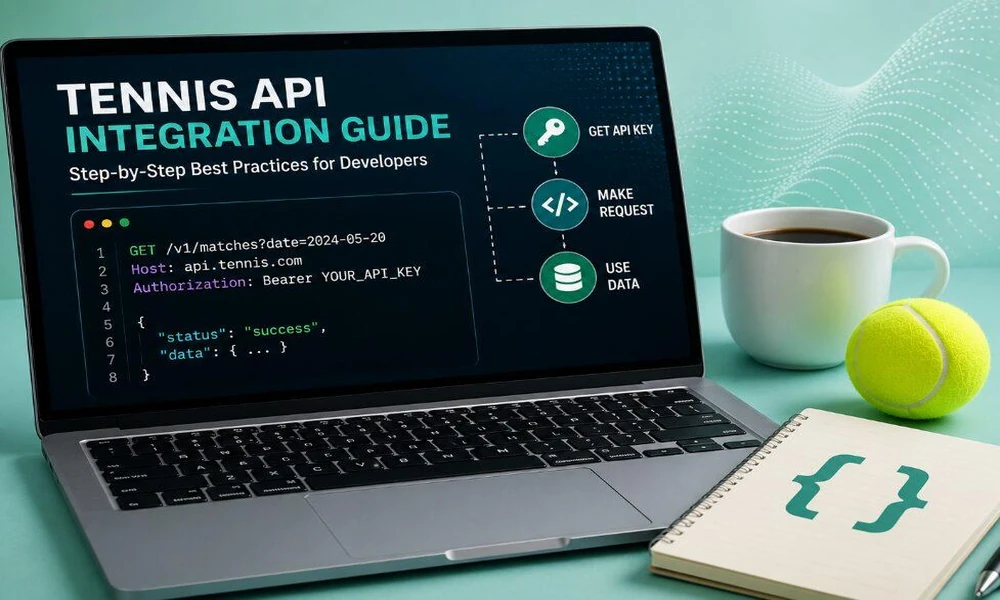
Real-time sports applications create an unusual engineering challenge.
Users expect information to appear almost instantly, yet the application needs to collect, normalize, cache and distribute constantly changing external data without exceeding API limits or overwhelming its own infrastructure.
Tennis is a particularly interesting example.
During a single match, the score can change dozens or hundreds of times. At the same time, the application may need to manage fixtures, player records, match statuses and historical information.
Developers building tennis products therefore need more than “an API that has scores.”
They need a data provider that fits the architecture of the product.
This article looks at several tennis API options and the technical factors developers should compare before choosing one.
What Can Developers Build With a Tennis API?
A quality tennis-data feed can power many types of applications.
Live Scoreboards
The most obvious use case is a real-time scoreboard showing active matches.
Tournament Websites
Developers can create schedules, completed-match pages and tournament dashboards.
Mobile Applications
Tennis data can support mobile match centers, personalized player tracking and notifications.
Analytics Platforms
Historical and detailed match information can be converted into statistics, visualizations and research tools.
SaaS Products
Developers can build commercial tennis-data applications for publishers, researchers or other businesses.
Content Automation
Structured data can also support automated match pages and data-enhanced editorial workflows.
Every use case requires a slightly different combination of information.
The Most Important Features to Compare
Before looking at individual providers, developers should prepare a requirements list.
Live Scores
For real-time applications, this is essential.
Look not only at whether live scores exist but also how efficiently they can be retrieved.
Fixtures
Upcoming match information powers schedules and notification systems.
Players
Applications need consistent player identifiers and structured information.
Match History
Historical results support analytical and editorial features.
Point-by-Point Records
Detailed match progression is useful for advanced statistics and visualization.
Odds
Some sports products require market information in addition to match results.
Rate Limits
Even excellent data becomes impractical if the application cannot retrieve it frequently enough.
Documentation
A technically strong API should also be understandable.
These factors provide a useful framework for comparing providers.
LiveTennisAPI
LiveTennisAPI is designed specifically around tennis data.
Instead of providing a huge general sports catalog, it concentrates on the information tennis developers are likely to use.
Its core data includes live scores, current matches, players and fixtures through JSON endpoints.
A free tier allows developers to make up to 30 requests per minute and 100 requests per day, with no payment card required.
For developers needing more advanced datasets, paid tiers expand access to historical information, point-by-point records, odds and other capabilities.
If you’re comparing specialist providers, one of the best tennis api choices to test is LiveTennisAPI because developers can begin with a working free tier and determine whether the data fits their application before scaling to paid functionality.
That is especially useful for independent developers, startups and teams validating a new sports product.
Sportradar
Sportradar is an established sports-data company serving professional and enterprise markets.
It can be a logical candidate for organizations that need extensive sports coverage and enterprise infrastructure.
A large media platform supporting many sports may value working with a broad provider because it reduces the need for multiple vendor relationships.
However, the requirements of an enterprise publisher and a tennis-focused startup are very different.
Smaller development teams should compare integration complexity, commercial requirements and actual tennis-data needs rather than selecting a vendor based purely on size.
SportsDataIO
SportsDataIO is another multi-sport provider developers may encounter.
Multi-sport APIs make sense when an application will eventually cover a range of sports.
For example, a company may want one backend responsible for:
- Tennis
- Football
- Basketball
- Baseball
- Other sports
Using fewer data vendors may simplify internal operations.
But if tennis is the only sport involved, developers should also compare specialist products.
The specialized API may provide a more focused developer experience.
Other Tennis-Focused APIs
There are also smaller providers dedicated primarily to tennis.
Some are available directly, while others can be discovered through API marketplaces.
Developers should include these options during initial research rather than restricting the shortlist to major sports-data brands.
However, they should test carefully.
The service must be reliable enough for the intended application.
How to Compare API Responses
Feature lists are useful, but developers ultimately work with responses.
That means a useful evaluation should include actual API calls.
Imagine two providers return the same live match.
Provider A may return a deeply nested response requiring substantial transformation.
Provider B might provide a straightforward match object containing the information the application actually needs.
Even if both technically offer the same data, Provider B may reduce development time significantly.
Build a small test script for each API.
Request:
- Current matches
- Upcoming fixtures
- Player information
- Completed matches, if included
- Detailed match information, where applicable
Then compare the output.
JSON Consistency Matters
Developers often focus on data volume and overlook consistency.
If fields behave differently across endpoints, development becomes harder.
A good integration should allow engineers to create predictable internal models.
For example:
Match
- match_id
- player_one
- player_two
- status
- score
- start_time
- tournament
The exact external format can differ, but it should be possible to translate responses into an internal model without excessive special-case logic.
Use a Backend Instead of Calling the Provider Directly
One of the most important architecture decisions is where the external API is called.
For most production applications, the frontend should not communicate directly with the sports-data provider.
Instead use:
External Tennis API -> Backend -> Cache -> Client
The backend controls request frequency and keeps the external API key private.
Security
API credentials are not exposed in client-side JavaScript.
Rate-Limit Protection
The server controls how frequently data is requested.
Caching
Thousands of visitors can reuse the same retrieved match information.
Data Transformation
The backend can convert provider-specific data into your application’s standard format.
Resilience
Recently cached data can remain available during a brief external-service interruption.
This architecture is useful regardless of which tennis-data vendor is selected.
Polling Strategies for Live Matches
Live tennis applications generally need more frequent updates during matches than outside them.
Instead of polling every endpoint at the same frequency, create separate refresh strategies.
For example:
Active Matches
Refresh relatively frequently because scores are changing.
Upcoming Fixtures
Refresh less often because the information changes far less frequently.
Historical Results
Cache for substantially longer periods because completed match results rarely change.
Player Records
Cache according to how frequently the relevant information changes.
This strategy reduces unnecessary API requests.
Why Historical Data Changes the Product
A live scoreboard can be built primarily around current matches.
But historical data enables a completely different level of functionality.
Developers can create:
- Recent-form indicators
- Player comparison pages
- Head-to-head features
- Tournament-history pages
- Data visualizations
- Research tools
- Analytical models
If these features are likely to appear later, choose a provider that gives the product a realistic path toward accessing them.
LiveTennisAPI, for example, begins with current tennis data on its free tier while more detailed historical and point-by-point information becomes available through paid access.
That gives developers a staged development route.
Why Point-by-Point Data Is Useful
Tennis has a naturally hierarchical scoring system:
Match -> Set -> Game -> Point
Final match results collapse all that information into a small number of scores.
Detailed point sequences preserve the story.
They can be used to build applications displaying momentum or reconstructing key periods of a match.
For a simple scoreboard, that may be unnecessary.
For a statistical platform, it can become one of the most valuable datasets available.
Test the API Under Realistic Conditions
A developer should avoid testing only one match.
Try different situations.
Test:
- Upcoming matches
- Live matches
- Completed matches
- Long matches
- Matches with unusual statuses
- Different competitions
Then determine how gracefully the application handles each response.
Testing edge cases early is much easier than discovering them after launch.
Calculate Request Consumption
The free tier of an API may be enough for development but not for a popular production application.
Estimate consumption before launch.
Suppose the backend retrieves a live endpoint six times per minute.
That is:
360 requests per hour.
If the service is active for ten hours:
3,600 requests.
Now add other endpoints.
This simple exercise quickly reveals which subscription level may eventually be necessary.
Caching and intelligent polling can reduce those numbers dramatically.
Documentation Can Save More Money Than Cheap Pricing
Engineering time is expensive.
An API that costs a few dollars less but requires several days of troubleshooting may not actually be cheaper.
Good documentation should make it clear how to:
- Authenticate
- Retrieve matches
- Query fixtures
- Interpret statuses
- Handle limits
- Process errors
Developers should include documentation quality in their provider scorecard.
Prototype With Several Providers
The safest selection process is practical.
Choose two or three realistic candidates and build the same small feature with each.
For example, create a page containing:
- Today’s tennis schedule
- Any currently live matches
- Player names
- Current scores
Then compare development effort and data usability.
Because LiveTennisAPI allows free access without a card, developers can evaluate it as a potential top tennis api before deciding whether more advanced paid features are required.
Which Type of Provider Is Best?
For a large multi-sport organization, an enterprise provider such as Sportradar may make sense.
For a general sports platform, a multi-sport API can reduce the number of vendors the engineering team needs to manage.
For a tennis-specific product, however, a specialized provider can offer a more focused route.
LiveTennisAPI is particularly interesting for developers who want to start with live scores, matches, players and fixtures without an upfront subscription and later expand into deeper tennis information as the product develops.
The right API should ultimately be chosen through testing, not brand recognition.
Compare the actual responses, documentation, coverage, rate limits, historical availability and cost at realistic traffic levels. An hour spent testing several providers can prevent months of unnecessary integration work later.